Sandustry starts strong: 97% positive Steam reviews after launch week
The solo-developed pixel-physics factory game reached a five-figure Steam peak, drew overwhelmingly positive early reviews, and received two fast post-launch updates.
Sandustry entered Early Access on August 13, 2026, and its first week has been unusually busy for a solo-developed factory game. When checked on August 20, Steam listed 1,473 English-language user reviews, 97 percent of them positive. SteamDB recorded an all-time peak of 12,551 concurrent Steam players on August 16. Those figures do not tell us how the full Early Access period will unfold, but they show that Lantto Games has found a much larger launch audience than most small automation games receive.
The release is available on Steam, GOG, and the Microsoft Store, with PC Game Pass access from day one. The standard price is €14.99, while a 35 percent launch discount runs until August 27. Steam also keeps a free demo available, which is useful here: Sandustry's defining idea is easy to describe, but its appeal depends on whether handling thousands of simulated particles feels satisfying to you.
A factory that has to negotiate with its world
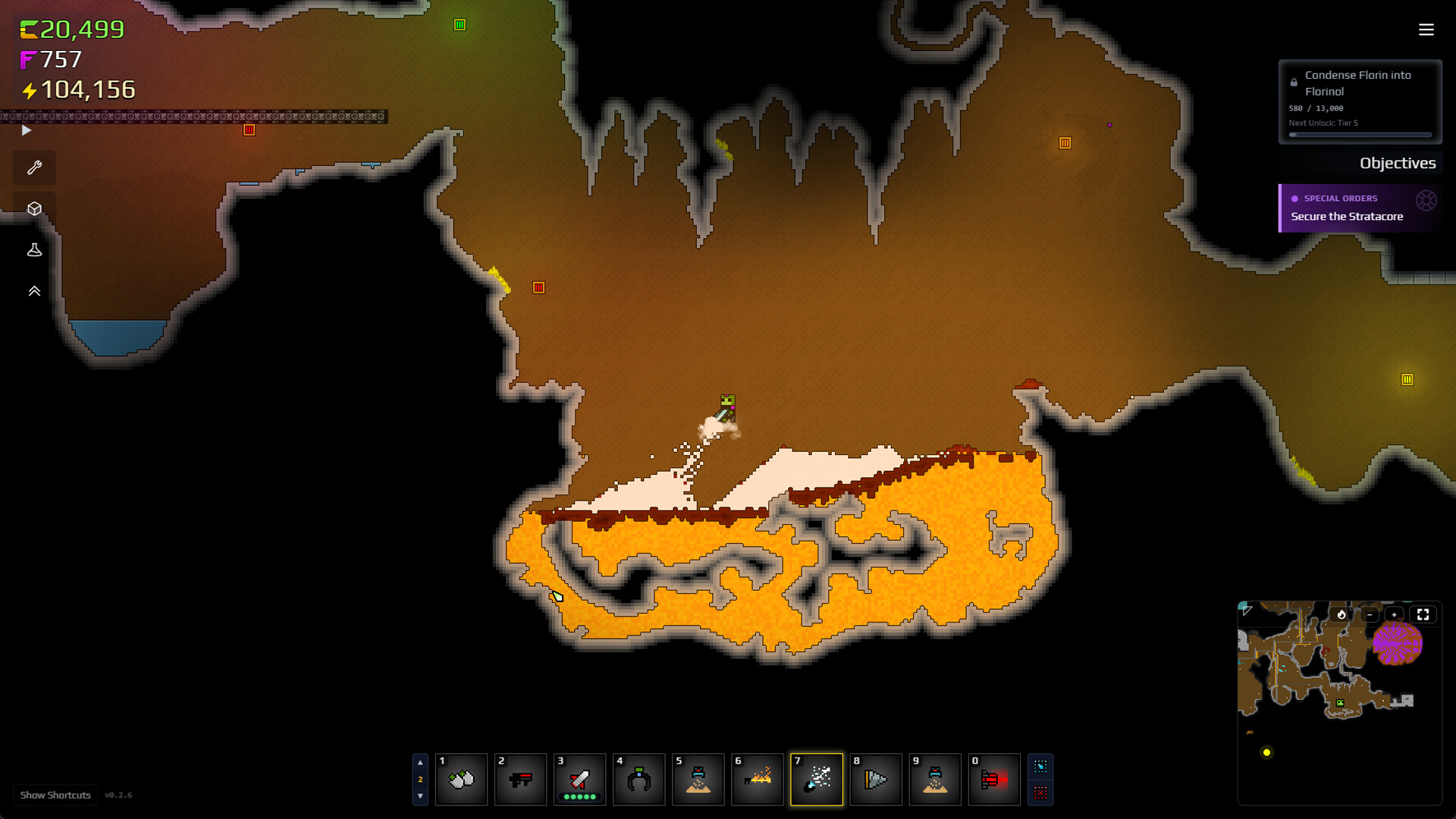
Every visible grain can be mined, moved, processed, mixed, or destroyed. Sand falls and absorbs water. Ice melts, water boils, steam rises, and poorly controlled materials can escape the route you designed for them. Conveyors, filters, pipes, pumps, lifts, drones, sensors, and logic tools gradually turn that restless terrain into a production network. The factory is never entirely separate from the cave around it.
That is the part that makes Sandustry more than a familiar automation loop in a 2D map. Progress comes from learning what each material does, then exploiting those reactions. Lava can be an obstacle or a tool. A flamethrower can open a route through ice. Ancient vaults and artifacts pull you away from the production floor and into the procedural world, where demolition and puzzle solving often overlap. Rock Paper Shotgun's launch coverage made the same distinction: the freedom to erase terrain matters because the environment itself remains part of the machine.
The first patches arrived quickly
The strong reception has not meant a frictionless launch. Lantto Games acknowledged crashes and other major issues in the first updates. Hotfix v0.5.3 arrived on August 14 with better diagnostic logging, lower memory use for clouds created by condensing steam, clearer objective messaging, and a launch option intended to help with some crashes. The developer said work on broader crash fixes was still ongoing.
Update v0.5.4 followed on August 16. It made filter editing less cumbersome, repaired a Tier 5 progression softlock, added a temporary way to remove indestructible red blocks, clarified save-browser icons, and added rebindable zoom controls. These are not glamorous additions, but they address the sort of small obstruction that can make a complex factory harder to read or maintain. Two updates in four days are an encouraging response, not proof that every technical problem has been solved.
What the launch does and does not prove
Sandustry's first-week numbers support one clear conclusion: its mix of factory planning and simulated matter has connected with players. The 97 percent recommendation share is especially notable because the launch build had already accumulated well over a thousand English reviews when checked. The five-figure concurrent-player peak also gives the workshop, wiki, and wider community a healthy starting point.
Early Access still matters. Lantto Games currently expects development to last roughly a year and plans more buildings, resources, production chains, quests, biomes, technologies, and finer procedural generation. The schedule may change with feedback, and the price may rise as the game grows. Players who want a finished progression curve or proven late-game stability should treat the current enthusiasm as a launch signal rather than a final verdict.
For factory fans who enjoy debugging messy physical systems, however, Sandustry is already one of August's releases to watch closely. Its first week delivered a rare combination: a distinct mechanical identity, a large audience, and a developer moving quickly through the first wave of problems.
Transparency
Sources and methodology
6 verified external sources
This article was researched using the primary and industry sources linked below. Links open in a new tab.