01 / Exact Steam split
Steam recommendations
Overwhelmingly PositiveSteam recommendations: 717 positive, 30 negative (747 total)
Playtime when reviewed
Latest 100 fetched reviews- < 1h
- 1
- 1–5h
- 21
- 5h+
- 78

by Buried Things • April 2, 2026
Boggle-ish roguelike with stickers, stamps and delightful madness.
Community evidence
This automated Steam evidence is separate from the BestOfGames review and editorial score.
All languages · all purchase types · Steam's default off-topic filtering
01 / Exact Steam split
Steam recommendations: 717 positive, 30 negative (747 total)
02–03 / Automated text analysis
Tone, topics, and time trend stay hidden until sample size, coverage, freshness, and classifier version are compatible.
A charmer that starts like Boggle and mutates into glorious nonsense—Cursed Words blends roguelike runs, sticker synergies and absurd tiles for players who love wordplay and creative chaos.
I went in expecting a clever indie word game and came out having typed chess pieces, numbers and emoji into victory screens. Cursed Words grabs the familiar comfy loop of Boggle and then gleefully snaps it in half—introducing stamps, stickers and cursed tiles that turn every run into a small experiment. If you like word puzzles that slowly unravel their own rules and reward lateral thinking, this one’s a joyful, occasionally maddening ride. It’s equal parts puzzling and performative: you’ll draft a shiny tile combo and also laugh when your submission reads like a ransom note with a saxophone soundtrack.
At its heart Cursed Words has you forming words from a grid, but that description is a generous understatement. Most runs begin like a comfortable word game—search for letter chains, chase multipliers and optimize your highest scoring submission. Very quickly, though, the loop expands: characters introduce unique pins and playstyles, stickers and stamps alter the rules, and consumable tiles let you bring numbers, chess pieces or even symbols into the board. I find myself switching between careful wordcraft and scramble-mode where the goal is to find the best interaction rather than the prettiest dictionary entry. Encounters are compact: two fights per stage and a boss, each of which can either punish sloppy builds or reward wild synergy, so every choice—what sticker to slap on, what stamp to equip—feels meaningful.
What makes Cursed Words stand out are its weird, mechanical toys. The sticker and stamp systems let you build synergies that would feel at home in a deckbuilder: some stickers buff specific tile types, others reroll board layouts or multiply point sinks; stamps tweak how submissions are scored or how enemies react. I loved discovering builds that turned mundane short words into scoring machines because a sticker boosted vowels or a stamp converted chess pieces into multipliers. There’s also a glorious list of challenges and crown difficulties that upend expectations—play with only consonants, only numbers, or no letters at all—and seeing how the systems bend (not break) under those constraints is a huge part of the fun. With 11 characters, 300 stickers and 300 stamps referenced in the blurbs, the combinatorial possibilities mean runs feel fresh for a long time.
Visually the game has a cozy, slightly mischievous aesthetic—cute character portraits, clear tile art and UI that keeps the chaos readable. Audio is a genuine highlight; the soundtrack and SFX add a lot of juice to otherwise procedural moments (yes, that sax is delightfully silly). Performance on my Windows rig was smooth; since Mac/Linux aren’t supported at launch, Windows players get the focus. Accessibility-wise the game doesn’t dumb things down: it rewards attention and experimentation, though a built-in glossary for obscure or generated “words” would be a nice QoL add. Controls are simple and the UX around submitting words and managing stamps/stickers is forgiving, which helps when runs devolve into delightful nonsense.
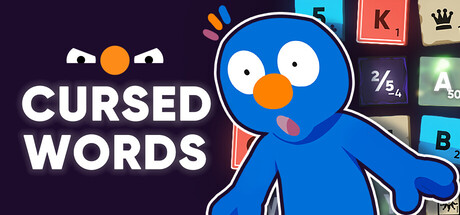
Cursed Words is a refreshing, weirdly satisfying take on word games: equal parts puzzler, roguelite and playful chaos. If you love discovering synergies, don’t mind rules that mutate mid-run, and appreciate a goofy soundtrack, this is worth your time. A few UX touches—like clearer word explanations—would make it even better, but as it stands it’s one of the most imaginative word-adjacent roguelites in recent memory.
Players are gushing over the game's inventiveness: the comparisons to Balatro and Scrabble come up constantly, and many reviews praise the charm, music and the depth of sticker/stamp interactions. Demo veterans say they logged double-digit hours before release and felt the full game delivers on those promises. Criticisms are consistent too—some players feel that late-game upgrades make the experience more about watching numbers rise than crafting words, and several reviewers asked for clearer explanations of odd or generated submissions. Replay value is a common thread: while many users love the variety, a few wonder if unlocking more stickers will dilute the thrill of finding a rare combo. Overall, if you like lateral thinking, quirky rules and a soundtrack that slaps, the community reaction is overwhelmingly positive.
Cursed Words is a refreshing, weirdly satisfying take on word games: equal parts puzzler, roguelite and playful chaos. If you love discovering synergies, don’t mind rules that mutate mid-run, and appreciate a goofy soundtrack, this is worth your time. A few UX touches—like clearer word explanations—would make it even better, but as it stands it’s one of the most imaginative word-adjacent roguelites in recent memory. Our score: 8.7/10.
Cursed Words: The Word Game That Isn't earns a score of 8.7 out of 10 from BestOfGames.
Cursed Words: The Word Game That Isn't is available on Windows.
Keep playing
Games like Cursed Words: The Word Game That Isn't
Similar indie titles you might love — curated by shared tags and score.
From the magazine
Eight standout indie picks, compared by play style, commitment, and possible deal-breakers so you can choose the right game rather than the highest number.
June 24, 2026
Eight solo indie games compared by pace, complexity, commitment, and likely deal-breakers, from active incremental systems to a quiet road trip and a wiring-heavy defense roguelike.
June 24, 2026